Active Hope can anchor you in an uncertain world

What do you hang on to when times are dark, confusing, when the world is uncertain?
Healthcare certainly generates feelings of despondency and hopelessness for many healthcare workers.
Dr Joanna Macy was a Buddhist scholar, environmental activist, author and teacher. She recognised long term action was required in the face of nuclear waste in the late 1970s, and that indigenous communities could show us beautiful ways we could respond to the problems of the world. She encouraged people to transform the world, society, by beginning with personal transformation and human connection.
She taught active hope. Active Hope, she said, is a realisation, a readiness to discover, and “grace happens when we act with others on behalf of our world” and that our strengths grow when we share them.
I read Macy and Johnstone’s book Active Hope a few years ago. Macy’s ideas have grounded me powerfully since in the face of challenge and helped my think about the healthcare system. Macy worked at the confluence of Buddhism, ecology, indigenous wisdom, and systems thinking.
She invited people to look inside themselves first, to be present, to acknowledge our interconnectedness with all things, especially our connection to nature, for the sake of seeing the present and the future in new ways. I have found her work so anchoring in my work, within healthcare with doctors.
She taught “the wonder is, that you’re able to suffer with your world, and that is good news indeed because to suffer with is the literal meaning of compassion, you are a compassionate being”. Active hope can anchor you in an uncertain world.
Dr Macy encouraged beginning with practicing gratitude for what is here, then to honour the pain that is in the world, including the grief we feel. Then to see with new, ancient eyes and finally to go forward in the world. Macy’s spiral can help us heal individually and collectively. This spiralling system can be endlessly repeated. We can always come back to our gratitude, our pain and reimagine ways to go forward in the world.
Dr Macy taught that we are not really free, until everyone is free. She described three systems that are all playing out simultaneously in an uncertain world.
- Business as usual (status quo)
- The great unravelling (disintegrating, breaking down)
- The great turning (transition from industrial growth to life sustaining civilizations)
It is useful to not get psychologically stuck on any one of these systems by themselves, as each might overwhelm us in their own way. We have the capacity to collectively rewrite the story when we recognise that the status quo, breaking down and transition to the new and unknown, are all happening at once, in different parts of different systems, that are interacting. Just as a garden can be sprouting, decaying and sustaining different plants, all at the same time. So is the healthcare system, which is really made up of many thousands of smaller systems.
In healthcare it is very easy to feel hopeless and uncertain, to feel that nothing changes, that we are stuck or even “going backwards”. Business as usual continues, but so does the dismantling of systems that are no longer relevant, and new systems are evolving, all at the same time.
For example, we still struggle to see equal representation of women leaders in the medical hierarchy (business as usual), at the same time we do have women physicians advancing up the hierarchy, having more voice than ever before (great unravelling), and there is now research demonstrating the benefits of women physicians (great turning) who are directing new ways for healthcare partnerships to develop, transitioning to new models of care, delivering healthcare differently.
Psychologist Charles Snyder developed Hope Theory in the 1990s saying that hope is a positive motivational state. He explained that hope requires goal directed energy (agency) and an ability to plan a pathway to meet the goal. To this end hope is, to use Macy’s word, an active choice, over despair, desperation and despondency. In fact, hope is a key predictor of wellbeing throughout the life span. Poor mental health is often linked to loss of energy and motivation, hopelessness. Active hope is a useful way to respond, to ground ourselves in a changing, uncertain world.
Hope = Agency + Pathways
Another elder, actor Jane Fonda, recently said she did not feel hope in her life until she became an activist. She learnt that hope is like a muscle that needs to be used often, on purpose. That choosing hope is a defiant act.
Hope can generate preventative and restorative actions and energy. Active Hope, the belief that the struggle will end, that suffering will ease, that someone will help us, allows humans to keep going forward, to thrive, even in times of adversity.
Hope is a complex topic for doctors because of the notion of giving patients ‘false hope’ . Many questions arise from here including what is false hope? Is it worse than no hope at all? Is hope the opposite of fear, or despair? And even what is the opposite of false hope? How does anyone know when a hope is false or when it will benefit? Perhaps a part two is called for, in the meantime these are important reflective questions for healthcare workers of all kinds.
As we bring 2025 to a close, I hope you can choose active hope, intentionally cultivate a hopeful mind and heart and be curious – see if it grounds you too in the face of uncertainty and change.
If these uncertain times feel too much for you, I encourage you to dig into hope theory and learn about Active Hope as taught by Dr Macy.
- Look for the hopeful people around you and spend time with them
- Remember you have a choice about where you put your attention, make space to honour your emotions including grief and despair
- Practice gratitude as often as you can.
- Get outside into the natural world every chance you can, create many pathways to the bush (forest) and the beach this holiday season.
As Martin Luther King said
“We must accept finite disappointment, but never lose infinite hope”.
Hope is a psychological strength. Active Hope gives us a reason to keep going, to experiment, to remain curious, to innovate. Hope is so much more than wishful thinking. Health care is a small phrase describing thousands of systems spiralling, as Macy described, simultaneously upwards, downwards and in stuck mode. To go forward we need each other, inspiring hope, compassionately reminding each other of our individual and collective agency and building pathways. It is in this active hope that we can create energy for the future.
References:
1.Macy, J and Johnstone, C. Active Hope. (2022) New World Library
2. Conscious being: Wisdom of Joanna Macy, The Joanna Macy Centre fror Resilience and Regeneration, Naropa University, YouTube
3. Snyder, CR (1994) The Psychology of Hope: You can get there from here. Free Press
4. Snyder, CR (2002) Hope Theory: Rainbows in the mind. Psychological Inquiry, 13(4), 249-275
5. Jane Fonda speaking at CareFest 2025, New York
==
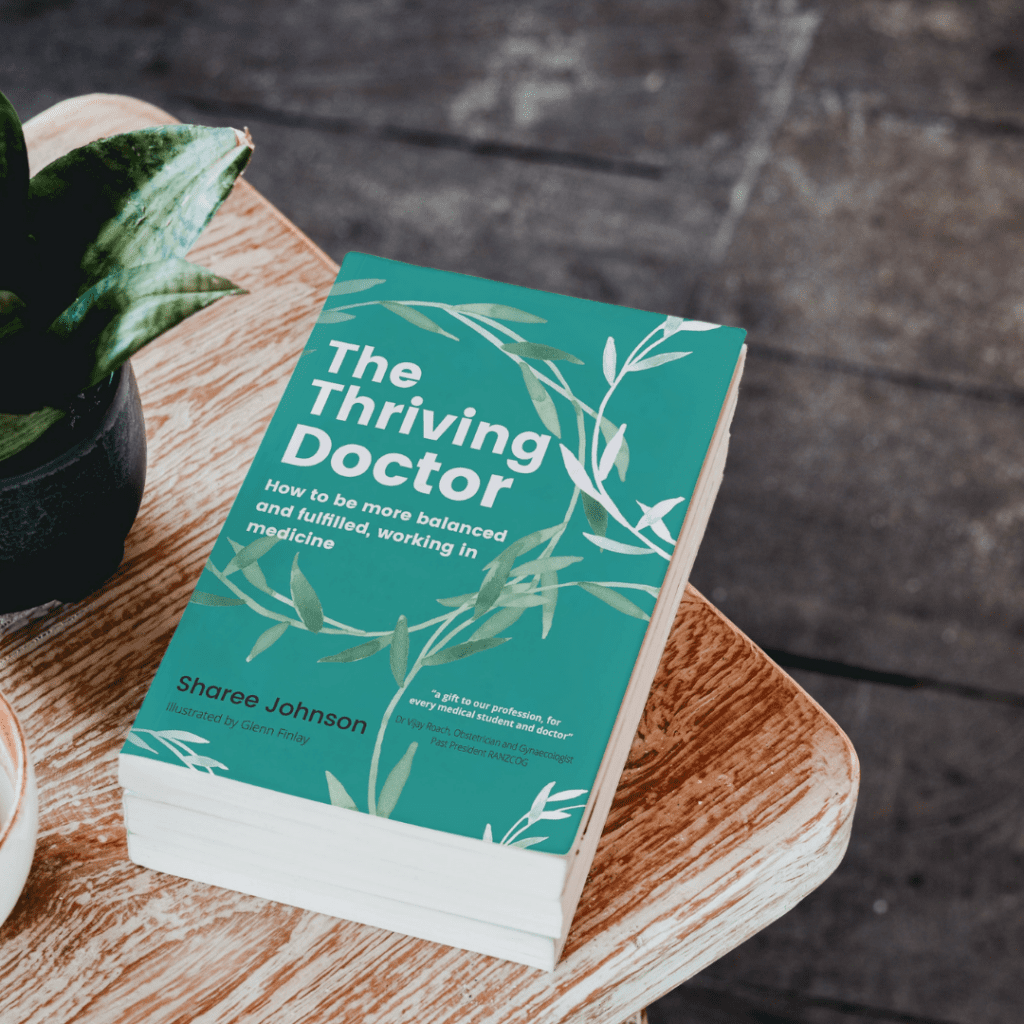
Sharee Johnson is the Founder, Managing Director, Principal Coach at Coaching for Doctors. She is the bestselling author of The Thriving Doctor: How to be more balanced and fulfilled, working in medicine and a Registered Psychologist. She has written extensively about doctor wellbeing, performance and coaching, delivers workshops to doctors and speaks at medical conferences. You can connect with her on Linkedin and Instagram.
Start by booking a call or sending me an email and let’s talk about how you or your team can experience the value and impact of professional coaching.
Recalibrate©
Immersion Development Program for Doctors
Restore Balance and Joy: Build your intra and interpersonal skills.
6 x 1:1 Coaching sessions with Psychologist Coach, Sharee Johnson
24 hrs Masterclasses with a closed group of doctors (max 12)
Develop in ways that will help you reconnect to your purpose.
The Thriving Doctor
Sharee Johnson’s book The Thriving Doctor is available in all good bookstores or online.
Sharee has been coaching doctors since 2014, find out more about her work
